Abstract
Scientific research is being conducted worldwide to purify process and wastewater generated by industrial enterprises to meet established requirements for reuse as circulating process water, to develop low-waste or waste-free technologies, and to comprehensively recycle solid and liquid waste generated during enterprise activities. In this regard, special attention is paid to purifying domestic, process, and industrial wastewater contaminated with various additives to meet established requirements and to use them as circulating water in the process or for watering trees and plants on the enterprise's territory. The scientific significance of the research results is that the effective course of the synthesis process for obtaining H-permutite depends on the type and ratio of components, and the efficiency of wastewater treatment is closely related to the degree of contamination and the environmental pH. The article presents general information on theoretical and practical research regarding methods and technologies for treating industrial, technical, and wastewater, based on published articles and patent literature. Based on the issues raised and a critical analysis of the data obtained, the article defines the research goals and objectives. Currently, there are both natural and artificial zeolites. In this scientific work, an alternative to zeolite, H-permutite, was synthesized from natural raw materials. In this article, the study of the structural properties of the molecular compounds of the samples was conducted on a Nicolet iS50 (Thermo Fisher Scientific, USA) FT-IR spectrometer. Measurements were carried out in the spectral range of 4000–400 cm⁻¹, with a spectral resolution of no more than 0.1 cm⁻¹. The test sample was pressed onto the surface of the mounted assembly with a flat-tip probe.
|
Published in
|
American Journal of Chemical Engineering (Volume 14, Issue 4)
|
|
DOI
|
10.11648/j.ajche.20261404.11
|
|
Page(s)
|
76-85 |
|
Creative Commons
|

This is an Open Access article, distributed under the terms of the Creative Commons Attribution 4.0 International License (http://creativecommons.org/licenses/by/4.0/), which permits unrestricted use, distribution and reproduction in any medium or format, provided the original work is properly cited.
|
|
Copyright
|
Copyright © The Author(s), 2026. Published by Science Publishing Group
|
Keywords
H-permutite, Adsorption, Specific Surface, Calcium Permutite, Sodium Permutite, Adsorbent, Hydrogen Permutite
1. Introduction
Beginning in the early 1940s, scientists at Union Carbide began research on the synthesis of zeolites, and they succeeded in synthesizing pure zeolites A and X in 1950
| [1] | Bambang Setiaji, Utilization of Zeolite for Adsorption of Benzopyrene as a Toxic Compound in Liquid Smoke. Science and Technology Magazine Vol. 11, No. 4, November (2000). |
[1]
. The discovery of zeolites in the world began in 1756 with the discovery of stilbite by a scientist named A. F. Constedt. Constedt described the peculiarity of this mineral: when heated, it seems to boil because the molecules lose water very quickly. According to these properties, this mineral was given the name zeolite, which comes from two Greek words, zeo, meaning boiling, and lithos, meaning stone (Kirk-Othmer, 1981)
| [2] | Wustoni, Shofarul, Rino Rahmata Mukti, Agus Wahyudi, Ismunandar, Synthesis of Zeolite Mordenite with the Help of Indonesian Natural Minerals, Journal of Mathematics and Science, Vol. 16, No. 3, (2011). |
[2]
. It is called a zeolite because it boils and emits steam when heated (Dyer, 1994). Zeolite is used in the separation and purification of petroleum hydrocarbons, as a catalyst, and in gas purification, drying, and separation of gases (including air), drying of freons, extraction of radioactive elements, and the creation of strong vacuums. Zeolite deposits exist in the Russian Federation (Voronezh), Armenia, and Georgia. In Uzbekistan, it is found among silts and opaque clays
| [3] | Djaeni, M., Laeli Kurniasari, Setia Budi Sasongko, Preparation of Natural Zeolite for Air Dehumidification in Food Drying, International Journal of Science and Engineering, Vol. 8, No. 2, (2015). |
| [4] | Solikah, Siti, Budi Utami, Differences in the Use of Adsorbents from Activated Natural Zeolite and Dithizone Mobilized Zeolite for Absorption of Cu2+ Copper Metal Ions, National Seminar on Chemistry and Chemical Education VI, Surakarta, (2014). |
[3, 4]
.
Table 1. Sodium silicate Liquid index M2.2Be50.
Sodium silicate standard | Sodium silicate standard 51°C | Test result |
Relative density (20°C)% | 50.0 ~ 51.0 | 50.7 |
Composition (Na2O)% | 12.8 | 13.95 |
Composition (SiO2)% | 29.2 | 31.05 |
Module (M) | 2.2 ~ 2.4 | 2.3 |
Table 2. Sodium silicate Liquid index M3.3Be38.
Sodium silicate standard | The sodium silicate standard is 38°C | Test result |
Relative density (20°C)% | 36.0 ~ 38.0 | 38 |
Composition (Na2O)% | ≥8.2 | 8.4 |
Composition (SiO2)% | ≥26.0 | 26.64 |
Module (M) | 3.1-3.40 | 3.27 |
Table 3. Sodium silicate Liquid index M2.2Be40.
Sodium silicate standard | The sodium silicate standard is 40°C | Test result |
Relative density (20°C)% | 38.0 ~ 40.0 | 38.9 |
Composition (Na2O)% | ≥9.5 | 39.1 ~ 40.0 |
Composition (SiO2)% | ≥22.1 | ≥22.1 |
Module (M) | 2.2 ~ 2.5 | 2.2 ~ 2.5 |
Table 4. Molecular mass ratio of zeolite.
Element | Symbol | Atomic mass | atomic num. | Mass percentage |
Sodium | Na | 22.9898 g/m | 1 | 100% |
Silicon | Si | 28.0855 g/m | 1 | 100% |
Oxygen | O | 31.9988 g/m | 2 | 100% |
2. Methodology
In the research on sorbents, the authors
| [5] | VS Galakhov, EP Aghasyan. VA Komarov. VA Uslikov and BB Blinov. A method of wastewater treatment for chromium compounds. Avt.sv. No 882951. MKI SSSR S02F1/70, (2015). |
[5]
used different materials and researched their sorption properties. Peat and sawdust-based sorbents have been proposed for softening technical waters in oil processing. Additionally, wood shavings containing cellulose have been recommended as a chemical reductant for the treatment of industrial wastewater containing certain heavy metals produced in galvanic plants due to the presence of cellulose-containing functional groups
| [6] | Sh. I. Berdiev, F. I. Erkabaev, D. A. Muxammadieva. Method for Obtaining H-permutite //Texas Journal of Multidisciplinary Studies. -Vol 12. -p 37-40, (2022). |
[6]
.
Bentonite, kaolinite, biotite, vermiculite, and glauconite recycled sorbents in various ways are effective and promising in softening industrial technical water and removing heavy metals because their natural resources are sufficient in our republic
| [7] | Zhamskaya, N. N. Study of the possibility of application of modified sorbents for wastewater treatment from protein substances / N. N. Zhamskaya. S. A. Mashkova, L. S. Byankina, N. P. Shapkin // Scientific works of the Far Eastern State Technical Fisheries University. - 2008. - № 20. - p. 37-40, (2008). |
[7]
. In addition, these minerals are relatively cheap, their deposits are widely distributed throughout the territory of our republic, their reserves have been studied, and their operational characteristics are high.
Adsorption properties of natural minerals are explained by their chemical and mineralogical structure, crystal structure, and dispersion of particles. The main components of natural minerals are SiO2 (30-70%), Al2O3 (10-40%), and H20 (5-10%); their relative surfaces are up to 500 m2/g.
Zeolites are used more often than permutates from mineral substances and synthetically obtained adsorbents because they have selective absorption properties. Permutites and zeolites consist of layered aluminosilicates [SiO4] 4 and [AlO4] 5, crystal lattices are tetrahedral. The microstructure of these adsorbents consists of layered channels, and the free movement of water molecules and cations improves their adsorption and ion exchange properties.
Zeolites exchange their cation (Ca2+, Na+, K+, Mg2+, etc.) with pollutant cations in wastewater or waste solutions, while they can selectively absorb.
To increase the sorption properties of zeolites, they are chemically modified with 3% chitosan solution or ferro ferricyanide complexes. In the process of obtaining the proposed H-permutite, this step is not performed. Despite the great demand for natural zeolites, the process of their application is not free from shortcomings, because the cracks in their crystal structure have certain sizes, and only small-sized ions can enter the space. In some processes, the sorption pores are not filled, which is caused by the relatively large size of absorbed ions. In addition, the ion exchange process is directly dependent on temperature, which limits the use of ultra-in-water treatment technologies.
Synthetic zeolites are free of these defects and are widely used in industry, but their use in water purification processes is not justified due to their relatively high cost and the complexity of regeneration processes. Therefore, it is urgent to use new types of adsorbents for cleaning technical or industrial wastewater, preparing them for use in boiler houses
| [8] | Sh. I. Berdiyev, F. I. Erkabayev. “THE USE OF H-PERMUTITE IN TECHNICAL WATER SOFTENING” №3/2023 year. Technical science and innovation, Tashkent, 2023. p. 18-25, (2023). |
[8]
.
As mentioned above, the treatment of industrial wastewater contaminated with various organic and inorganic substances, and the softening of technical water for reuse, are relatively expensive processes. The reason for this is that most of the adsorbents used in the cleaning process are imported, and the regeneration processes are complicated
| [9] | Asilbek Mamatkulov and Furkat Erkabaev. Factors affecting electrolytic level maintenance in acid batteries. E3S Web of Conf. Volume 401, 2023 V International Scientific Conference “Construction Mechanics, Hydraulics and Water Resources Engineering” (CONMECHYDRO - 2023).
https://doi.org/10.1051/e3sconf/202340103067 |
[9]
. Taking this into account, research was conducted on obtaining aluminosilicate adsorbent with a layered structure, that is, H-permutite. H-permutite softens technical water up to the established requirements and is very effective in obtaining circulating water for boilers, where the softened water is not contaminated with Na+ ions, as in the case of Na-permutite application.
Various mineral and artificial adsorbents, including Na-permutite, are used in industry for wastewater treatment and softening of technical waters. When Na-permutite is used for water softening, the calcium and magnesium ions in the water are softened due to the exchange of equivalent amounts of sodium ions. In this case, the water is cooled, free of calcium and magnesium ions, which give hardness, but its mineralization remains unchanged due to sodium ions, which do not give hardness properties
| [10] | Эркабаев Ф. И, Мадримов Р. М., Нурматова В. Б. “Status quo analysis of the Aidar-Arnasay Lake System”. 5th International Conference on Energetics, Civil and Agricultural Engineering (ICECAE 2024), E3S Web Conf. Volume 497, 07 March 2024, https://doi.org/10.1051/e3sconf/202449702025 |
[10]
. If H-permutite is applied to this process, the mineralization of water decreases, the efficiency of steam boilers increases dramatically, and especially the efficiency of high-pressure steam boilers improves, and the useful work coefficient increases dramatically.
It is known that permutates can be synthesized in an aqueous environment with the presence of aluminum sulfate or aluminum chloride and sodium silicates, where the ratio of components plays a major role in the product yield. For the synthesis of H-permutite, experiments were conducted using aluminum chloride and sodium silicates in different proportions (
Table 5).
Table 5. Obtained proportions of aluminum chloride and sodium silicates for the synthesis of H-permutite.
t/r No | Aggregate status | Components, g/l | Efficiency,% |
Water solution | NaSiO3·9H2O | AlCl3 |
1 | 1:1 | 25.0 | 5.0 | 47 |
2 | 1:1 | 25.0 | 4.5 | 48 |
3 | 1:1 | 25.0 | 4.0 | 50 |
4 | 1:1 | 25.0 | 3.5 | 51 |
5 | 1:1 | 25.0 | 3.0 | 49 |
6 | 1:1 | 25.0 | 2.5 | 45 |
7 | 1:1 | 24.0 | 5.0 | 46 |
8 | 1:1 | 24.0 | 4.5 | 48 |
9 | 1:1 | 24.0 | 4.0 | 50 |
10 | 1:1 | 24.0 | 3.5 | 52 |
11 | 1:1 | 24.0 | 3.0 | 51 |
12 | 1:1 | 24.0 | 2.5 | 48 |
13 | 1:1 | 23.0 | 5.0 | 49 |
14 | 1:1 | 23.0 | 4.5 | 51 |
15 | 1:1 | 23.0 | 4.0 | 53 |
16 | 1:1 | 23.0 | 3.5 | 54 |
17 | 1:1 | 23.0 | 3.0 | 52 |
18 | 1:1 | 23.0 | 2.5 | 50 |
19 | 1:1 | 22.0 | 5.0 | 44 |
20 | 1:1 | 22.0 | 4.5 | 46 |
21 | 1:1 | 22.0 | 4.0 | 48 |
22 | 1:1 | 22.0 | 3.5 | 51 |
23 | 1:1 | 22.0 | 3.0 | 49 |
24 | 1:1 | 22.0 | 2.5 | 45 |
From the results of the conducted experiments, it became clear that the efficiency was the highest when the amount of Na
2SiO
3·9H
2O was 23 g, and the amount of AlCl
3 was 3.5 g in the synthesis process, and it was 54%. To synthesize H-permutite in optimal proportions, 23.0 grams of Na
2SiO
3·9H
2O were dissolved in 1 L of distilled water at room temperature (
1), and 3.5 g of AlCl
3 were also dissolved in 1 L of distilled water and mixed for 10 minutes. In this case, the process proceeds according to the following equation in aqueous medium at room temperature:
2AlCl3+ 3Na2SiO39H2O +H2O = Na2Al2Si2O8↓ · nN2O + 6NaCl + SiO2(1)
The formed Na
2Al
2Si
2O
8 reacts with added CaHCO
3 to form Ca
2Al
2Si
2O
8. After treatment with 5% HCl, H
2Al
2Si
2O
8 (H-permutite) is formed and precipitates, while NaCl and SiO
2 ions remain in solution. The precipitate was filtered and dried to constant weight at 1200°C, and the efficiency was determined. The weight of our obtained product was 19.6 g, and the efficiency of the process was 74%. A sample of 2.2 kg of H-permutite was taken under optimal conditions determined by this technology. Navbakhor mine bentonite was added to the obtained sample in the amount of 5% as a plasticizer and granulated. To determine the amount of water needed for granulation, samples with different amounts of water added to the mixture were prepared and tested (
Table 6).
Table 6. Required for the granulation of H-permutite, determine the amount of water.
t/r No | Sample | Moisture,% | Water content,% | Result |
1 | H2Al2Si2O8 | 4 | 19 | The granules are broken, emulsifying |
2 | H2Al2Si2O8 | 4 | 20 | The bulk of the granules is whole, emulsifiable |
3 | H2Al2Si2O8 | 4 | 21 | The granules are whole, and the consistency is sufficient |
4 | H2Al2Si2O8 | 4 | 22 | The granules are whole, slightly sticky due to moisture |
5 | H2Al2Si2O8 | 4 | 23 | Granules are partially deformed, sticky |
6 | H2Al2Si2O8 | 4 | 24 | The shape of the granules is distorted, and the shape is variable |
Table 6 shows that when we added 5% bentonite and 21% water to a sample with a moisture content of 4%, a mixture with optimal moisture content for granulation was obtained. The prepared mixture was granulated in an FSH-0.004M laboratory granulator with a 3.0 mm diameter. The prepared granules were dried for 1 hour at a temperature of 1800C with periodic mixing. The dried granules were sieved through laboratory sieves, and the fraction between 1 and 3 mm was separated. This fraction was 92%.
The obtained product was placed in a sorption column with a diameter of 50 mm and a height of 200 mm. To check the absorption of Fe
2+ ions, a model solution with a concentration of 22 mg/l (the wastewater of METFURSERVIS LLC contains 22 mg/l Fe
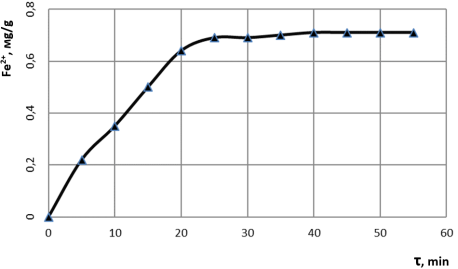
2+ ions) was prepared. The results of the experiment to determine the adsorption kinetics of the obtained sorbent on Fe
2+ ions are presented in
Figure 1.
Figure 1. Adsorption kinetics of Fe2+ ions from a model solution with a concentration of Fe2+ ions of 22 mg/l.
As can be seen from
Figure 1, the sorption process of Fe
2+ ions is fast in the first 20 minutes, the adsorbent is approaching saturation, and the process is relatively slow in the next 30 minutes. The obtained results showed that the absorption capacity of the obtained adsorbent was 0.65 mg/g in terms of Fe
2+ ions.
Based on the data obtained as a result of the conducted research, the optimal proportions of raw materials for obtaining H-permutite were determined, the possibilities of separating the product from the water part, choosing a plasticizer for granulation, and determining the optimal amount of water added for granulation were created. The obtained granules were dried in the established order, granulated and dried, and placed in a sorption column, and their sorption properties were studied. Based on the test results, it can be concluded that the obtained product is a good adsorbent material, has a good effect on water purification and softening, and reduces mineralization.
H-permutite can be used in the preparation of electrolytes for various electrochemical processes and the preparation of water for high-pressure steam boilers. Doing so ensures their effective operation and leads to a sharp increase in the useful work coefficient due to the reduction of the processes of cleaning the formed clots.
3. Review the Planning Stage
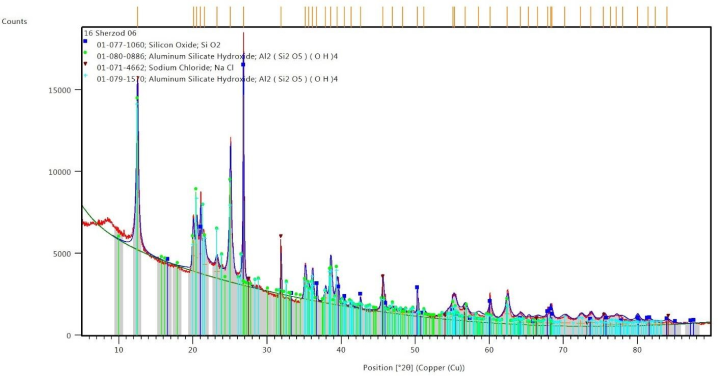
Measurement of the phase characteristics of the studied samples by an X-ray diffractometer was carried out on a Panalytical Empyrean powder X-ray diffractometer. All monitoring of equipment performance was performed by computer using Data Collector software and X-ray diffraction pattern analysis software
| [11] | Mazloomi, F., Jalali, M., Ammonium Removal from Aqueous Solutions by Natural Iranian Zeolite in the Presence of Organic Acids, Cations, and Anions. Journal of Environmental Chemical Engineering, (2015). |
[11]
. Measurements were taken at room temperature in a 2-angle range, 5° to 90° stepwise scan mode with 0.013 (2-Main Graphics, Analyze View: 2-Sample X-ray Analysis) degree step, and the signal at 5 s point was collected with the collection time and IK. To study the characteristics of the structure of the molecular compounds of the studied samples, the Nicolet iS50 (Thermo Fisher Scientific, AQS H) IR-Fourier spectrometer was used. Measurements were made in the 4000-400 cm-1 spectral range, with spectral resolution not exceeding 0.1 cm. The test specimen was pressed against the mounting surface with a flat-tip probe
| [12] | Millar, G. J., Winnet, A., Thompson, T, Couperthwaite, S. J., Equilibrium Studies of Ammonium Exchange with Australian Natural Zeolites. Journal of Water Process Engineering 9 47-57, (2016). |
[12]
. The following analysis values were determined using a pinhole and diamond crystal to measure near, mid, and far IR attenuated total internal reflection (ATR) at IS50.
Figure 2. (A) X-ray phase analysis results of the labeled zeolite.
If the water is hard (the total amount of calcium and magnesium salts in its content is higher than normal), it is softened. Groundwater is often de-ironed (enriched with oxygen) by aeration. Lime, sodium aluminate NaAlO
2, and sometimes burnt dolomite are used for water desilicification (reducing the amount of metasilicic acid H
2SiO
3 and its salts)
| [13] | Marakatti VS, Halgeri AB, Shanbhag GV. "Metal ion-exchanged zeolites as solid acid catalysts for the green synthesis of nopol from the Prins reaction". Catal. Scientific work. Technol. 4(11): 4065–4074.
https://doi.org/10.1039/C4CY00596A
S2CID 94555012, (2014). |
[13]
. To remove other dissolved salts in the water, it is sweetened or desalinated with ions. Water is degassed to remove hydrogen sulfide, methane, radon, carbon dioxide, and other dissolved gases. The water is filtered through activated alumina to reduce excess fluoride in the water. If the water is found to contain radioactive substances, it will be deactivated. If the water has a strong smell, it is treated with activated carbon, ozone, potassium permanganate, or chlorine dioxide.
In Uzbekistan, it is found among silts and opaque clays. Gilmoya is one of the types of clay. Consists of montmorillonite. In Uzbekistan, gilmoya is also called gilvata, mountain oil, and stone soap. Gilmoya is mainly formed from the physical and chemical transformation of volcanic ash and clay in the alkaline environment at the bottom of the sea and ocean. Color is white, green, gray, brown, etc. Soap-like and soft, it dries quickly in the heat and turns into stone. In water, its volume increases 2-15 times. Gilmoya can also absorb (adsorb) various substances and radioactive elements. When heated to 1110-1125°C, it expands and turns into a porous stone - expanded clay. Clay soil is widely used in rubber, paper, metallurgy, the food industry, medicine, and agriculture. Gilmoya is widespread in the Cretaceous and Paleogene strata. It has been determined that there are about 200 clay soil deposits in Uzbekistan.
Table 7. Chemical composition of permutite (%).
Si | Al2 | Fe | Ti | No | O | Cl | K | C |
22.39 | 14.89 | 1.08 | 0.39 | 11.36 | 42.73 | 0.77 | 0.27 | 6.13 |
Aluminum trichloride was used for the synthesis of permutite hydrogen, for which 23.5 grams of NaSiO
3 9H
2O were dissolved in a volume of 2 L of distilled water and 3.4 grams of AlCl
3 in a volume of 1 L of distilled water, and stirred for 10 minutes. at room temperature (
2). The reaction chemistry of this process can be described as follows:
2AlCl3+ 3Na2SiO3·9H2O + H2O = H2Al2Si2O8·nH2O↓ + 6NaCl + SiO2(2)
After that, the resulting product, namely hydrogen permutite precipitates, NaCl, and SiO
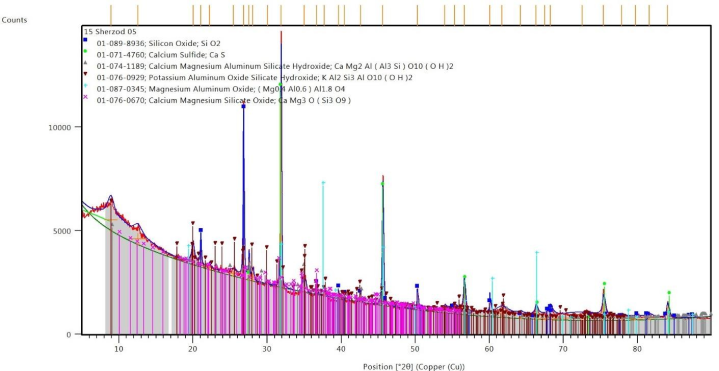
2, remains in solution. The product is filtered, washed, dried at a temperature of 110°C to a constant weight, and the yield of the product is determined. In our case, the dried product was 14.3 grams, and its yield was 53%. Using this technology, a sample of 1.1 kg of hydrogen peroxide was obtained. The resulting product is granulated, for which 8% enriched bentonite from the Navbahor mine is added as a plasticizer. Water was added to the pre-determined optimal amount of granulation, which was 21%, and water was added in an FSH-004 laboratory granulator with a screw hole diameter of 1.0 mm. The finished granules were dried at a temperature of 175°C, stirring from time to time. The dried granules were sieved, 1-3 mm fractions were sorted to study the sorption properties. We saw that the x-ray analysis of the obtained sorbent (
Figure 3) is proportional to the x-ray analysis of zeolite.
Figure 3. Results of X-ray phase analysis of hydrogen peroxide.
The obtained data made it possible to determine the optimal ratio of components for the production of hydrogen peroxide, the resulting product was separated from the aqueous medium, the plasticizer and the optimal amount of water were selected, and granules of a certain fraction were obtained
| [14] | Igbokwe P. K, Okolomike RO., and Nwokolo SO. (2008). Zeolite for Drying of Ethanol-Water and Methanol-Water Systems from Nigerian Clay Resource, Journal of The University of Chemical Technology and Metallurgy, 43: 109-112. |
[14]
. The obtained granules are dried and placed in a sorption column, and their sorption properties are checked. As a result, the obtained product is a good adsorbent, it does not pollute the water environment in the process of softening and cleaning water, and reduces mineralization. The resulting product can be successfully used in the production of electrolytes containing high-pressure steam and can be successfully used in cleaning water from boilers. Meanwhile, effective softening and a decrease in the general mineralization of water have a positive effect.
4. Source Discovery Stage
Zeolite, as an ion exchanger, can exchange cations with other ions in the surrounding solution. With this property, zeolite-A with Na
+ ions can be used as a water softener, where Na
+ ions replace Ca
2+ ions from hard water. Zeolite saturated with Ca
2+ can be renewed by dissolving it in a pure Na
+ or K
+ salt solution. Zeolite-A is now added to detergents as a water softener to replace polyphosphates, which can cause environmental damage. Production of potable water from seawater using a mixture of Ag and Ba zeolite is a good desalination process, although the process is relatively expensive
| [15] | Aguado, S., Jorge, G., Jacobus, C. J., and Freek, K. (2009). Continuous Synthesis of NaA Zeolite Membranes. Microporous and Mesoporous Materials. 120: 170-176. |
[15]
.
Aluminum chloride is hygroscopic, which means it can absorb moisture from the air. Normally, this chemical compound evaporates in air containing moisture. Makes a hissing sound when it comes into contact with water. During the reaction, Cl
- ions are replaced by H
2O molecules (
3), forming the hexahydrate [Al(H
2O)
6] Cl
3. The anhydrous state of AlCl
3 is lost, and when heat is applied, HCl is also released, and the final product obtained is aluminum hydroxide.
Al(H2O)6Cl3→ Al(OH)3+ 3HCl + 3H2O(3)
When the temperature rises to about 400°C, aluminum oxide is formed from the hydroxide (
4).
A characteristic feature of aqueous solutions of AlCl
3 is that they are ionic. Therefore, they conduct electricity well (
5). They are also acidic, and this can lead to partial hydrolysis in the Al
3+ ion. The reaction can be written as:
[Al(H2O)6]3+(aq)⇌[Al(OH)(H2O)5]2+(aq) + H+(aq) (5)
Aluminum salts containing the hydrated Al
3+ ion are similar to aqueous solutions of aluminum chloride. They do the same (
6). For example, when reacting with dilute sodium hydroxide, a thick precipitate of Al(OH)
3 is formed.
AlCl3+ 3NaOH → Al(OH)3+ 3NaCl(6)
Aluminum chloride is often regarded as a versatile chemical compound and is therefore used in many fields, especially in chemical reactions and synthesis. We will learn about the use of aluminum chloride below.
1) AlCl3 is mainly used as a catalyst for various chemical reactions. It is widely used in Friedel-Crafts reactions, including acylations and alkylations. It is used in the preparation of anthraquinone from phosgene and benzene.
2) Aluminum chloride can be used to introduce or attach aldehyde groups to aromatic series or rings. For example, we can consider the Gattermann-Koch reaction, in which a Lewis acid (aluminum chloride) is used to remove a chloride ion from a species.
3) It is also used in polymerization and isomerization reactions of light molecular hydrocarbons. Some common examples include the production of dodecylbenzene for detergents.
4) To synthesize bis(arene) metal complexes, aluminum chloride can be mixed with aluminum, along with arene.
5) Aluminum chloride has a variety of other applications, particularly in organic chemistry. For example, it is used to catalyze the "ene reaction". We can take the example of the addition of 3-buten-2-one to carvone (methyl vinyl ketone).
6) Aluminum chloride is used to induce various hydrocarbon compounds and rearrangements.
Industrial Uses of Aluminum Chloride (AlCl3)
1) Aluminum chloride is widely used in the production of rubber, lubricants, wood preservatives, and paints.
2) Used in pesticides and pharmaceuticals.
3) As flux in aluminum smelting.
4) Used as an antiperspirant.
5) It is also used in the production of petrochemicals such as ethylbenzene and alkylbenzene.
5. Know-how Stage
For comparison, the industrial test experiments showed that the modified glauconite sorbent could soften the technical water of the enterprise with a hardness of 15 mg-eq/l to 7.0 mg-eq/l, while the H-permutite sorbent proposed by the researcher had a hardness of 15 showed that technical water with mg-eq/l can be softened up to 3.5 mg-eq/l, which in turn allows to recycle technical water at the enterprise and use it in high-pressure boilers (table). After saturation, the proposed sorbent can be regenerated and reused up to 9-11 times. The volume of washing water produced during the regeneration process is relatively small. The used sorbent is rich in microelements and recommended to be added to mineral or local fertilizers.
Comparison of Si and Al from zeolites describes the function of their cation exchange capacity. Data from XRF analysis shows that the percentage comparison between SiO
2 and Al
2O
3 is relatively smaller, namely 5.56
| [16] | Ackley M. W, Rege S. U., and Saxena H. (2003), Application of Natural Zeolites in the Purification and Separation. Journal of Microporous and Mesoporous Materials. 61, 25- 42. |
[16]
. This comparison theoretically shows that the capacity of the cations is relatively large. These results were obtained in Natural zeolite that has been processed using acid.
HCl reacts with zeolite to extract Al from the zeolite. This resulted in decreasing the Al content in the zeolite so that the ratio of Si/Al moles increases. Metal content, such as Ca and Mg in zeolite, decreased after treatment due to ion exchange between cations from zeolite with protons from HCl. Analysis results using XRF show that the acid treatment process (HCl 5 M) on the catalyst causes a decrease in Ca and Mg metal content in zeolites and an increase in zeolite acidity. Chemical activation carried out by acidification with the aim of agar dealumination occurs. The purpose of dealumination is to optimize aluminum content in zeolite, so that the zeolite becomes more stable at high temperatures, controlling acidity and zeolite selectivity. Dealumination is a process of destruction of the zeolite framework structure that occurs as the disconnection of Al in the framework (Al framework) becomes Al outside the framework (Al non-framework). As a result, the Si/Al ratio will increase
| [17] | Kamarudin KSN, Mat H, dan Hamdan H (2003). Structural Synthesis and Modification of Zeolite as Methane Adsorbent. Paper of University Teknologi Malaysia submitted at Annual Fundamental Science Seminar, 13(2): 272-278. |
[17]
.
6. Results and Discussion
Currently, many ion-exchange materials are found of natural origin: humus and brown coal, peat, wood, starch, glauconite, volkonskoite, bentonite, and other aluminosilicates created according to the type of naturally or artificially created zeolite. (zeolites), - permutite, etc. However, all these materials are characterized by a small ion exchange capacity, different designs of ion filters have been proposed and put into use, and they all have a parallel flow (purified water and regeneration solution flow in the filter in the same direction - from top to bottom). The results of our studies showed that we can achieve economic efficiency if we clean technical water and boiler water using H-permutite. It was found that the cost of generating H-permutite is much lower compared to other adsorbents. We can achieve economic efficiency by producing mineral-rich plant fertilizer from spent H-permutite.
7. Conclusion
The maximum adsorption of the dye solution occurred at pH 3. Here, an equilibrium was reached between the dye and the hydroxyl ions in the solution. so that the dye could capture the added hydroxyl ions, and the dye solution experienced a decrease in adsorption capacity at higher levels. If analyzed in the neutral pH range, the reactive dye could cause oxidation on its surface, as a result of which it imparted a positive charge to the zeolite surface. A sharp decrease in adsorption capacity was observed at alkaline pH. This is because alkaline pH was observed to inhibit the increase in protonation in the dye solution. This is because too many OH- ions in the solution could not be captured by the dye, so there were still many free OH- ions in the solution, which caused competition between the dye and the free OH- ions for occupying the zeolite surface, which reduced the adsorption capacity of the substance. OH- neutralizes the methylene blue solution so that the negative charge tendency on the adsorbent does not attract the adsorbate. At high pH, the surface of the reactive dyes increased positively charged cations through attractive electrostatic forces. Increasing alkalinity was observed to change the adsorbent layer from positive to negative. Therefore, it reduced the adsorption capacity. Scientific research and scientific news of the following consists of:
1) H-permutite synthesis in the process, the raw items ratio plays a big role in this component. The ratio of Na2SiO3: AlCl3 is 6: 1 when processing the product most efficiently, and the output is 74% organize did.
2) Synthesis Na-permutite when AlCl3 is used in the process harvest to be processed, in which Na+ ions are the main part, and Cl- ions bind to the solution passed, and in the sediment, H-permutite is left.
3) Technician the water H-permuted with the help of when cleaned of water ion replacement to account for mineralization, sharp decrease, and high-pressure working warm up their stomachs prevention cleaning of the process, decrease to account for useful work coefficient, sharp brought.
4) H-permutite studies as a result determined component proportions and another optimal parameter based on high exit with synthesis to create technology.
Abbreviations
ATRR | Attenuated Total Internal Reflection |
AlCl3 | Aluminum Chloride |
Author Contributions
Sherzodbek Berdiev: Formal Analysis, Methodology, Supervision
Shuxrat Buxorov: Conceptualization, Formal Analysis, Methodology
Jamshid Kayumov: Conceptualization, Formal Analysis, Methodology
Mirolim Aripov: Data Curation, Formal Analysis, Methodology, Writing – original draft, Writing – review & editing
Akbarjon Khadjibaev: Formal Analysis, Methodology, Supervision
Pirimov Tuychi: Conceptualization, Formal Analysis, Methodology
Conflicts of Interest
The authors declare no conflicts of interest.
References
| [1] |
Bambang Setiaji, Utilization of Zeolite for Adsorption of Benzopyrene as a Toxic Compound in Liquid Smoke. Science and Technology Magazine Vol. 11, No. 4, November (2000).
|
| [2] |
Wustoni, Shofarul, Rino Rahmata Mukti, Agus Wahyudi, Ismunandar, Synthesis of Zeolite Mordenite with the Help of Indonesian Natural Minerals, Journal of Mathematics and Science, Vol. 16, No. 3, (2011).
|
| [3] |
Djaeni, M., Laeli Kurniasari, Setia Budi Sasongko, Preparation of Natural Zeolite for Air Dehumidification in Food Drying, International Journal of Science and Engineering, Vol. 8, No. 2, (2015).
|
| [4] |
Solikah, Siti, Budi Utami, Differences in the Use of Adsorbents from Activated Natural Zeolite and Dithizone Mobilized Zeolite for Absorption of Cu2+ Copper Metal Ions, National Seminar on Chemistry and Chemical Education VI, Surakarta, (2014).
|
| [5] |
VS Galakhov, EP Aghasyan. VA Komarov. VA Uslikov and BB Blinov. A method of wastewater treatment for chromium compounds. Avt.sv. No 882951. MKI SSSR S02F1/70, (2015).
|
| [6] |
Sh. I. Berdiev, F. I. Erkabaev, D. A. Muxammadieva. Method for Obtaining H-permutite //Texas Journal of Multidisciplinary Studies. -Vol 12. -p 37-40, (2022).
|
| [7] |
Zhamskaya, N. N. Study of the possibility of application of modified sorbents for wastewater treatment from protein substances / N. N. Zhamskaya. S. A. Mashkova, L. S. Byankina, N. P. Shapkin // Scientific works of the Far Eastern State Technical Fisheries University. - 2008. - № 20. - p. 37-40, (2008).
|
| [8] |
Sh. I. Berdiyev, F. I. Erkabayev. “THE USE OF H-PERMUTITE IN TECHNICAL WATER SOFTENING” №3/2023 year. Technical science and innovation, Tashkent, 2023. p. 18-25, (2023).
|
| [9] |
Asilbek Mamatkulov and Furkat Erkabaev. Factors affecting electrolytic level maintenance in acid batteries. E3S Web of Conf. Volume 401, 2023 V International Scientific Conference “Construction Mechanics, Hydraulics and Water Resources Engineering” (CONMECHYDRO - 2023).
https://doi.org/10.1051/e3sconf/202340103067
|
| [10] |
Эркабаев Ф. И, Мадримов Р. М., Нурматова В. Б. “Status quo analysis of the Aidar-Arnasay Lake System”. 5th International Conference on Energetics, Civil and Agricultural Engineering (ICECAE 2024), E3S Web Conf. Volume 497, 07 March 2024,
https://doi.org/10.1051/e3sconf/202449702025
|
| [11] |
Mazloomi, F., Jalali, M., Ammonium Removal from Aqueous Solutions by Natural Iranian Zeolite in the Presence of Organic Acids, Cations, and Anions. Journal of Environmental Chemical Engineering, (2015).
|
| [12] |
Millar, G. J., Winnet, A., Thompson, T, Couperthwaite, S. J., Equilibrium Studies of Ammonium Exchange with Australian Natural Zeolites. Journal of Water Process Engineering 9 47-57, (2016).
|
| [13] |
Marakatti VS, Halgeri AB, Shanbhag GV. "Metal ion-exchanged zeolites as solid acid catalysts for the green synthesis of nopol from the Prins reaction". Catal. Scientific work. Technol. 4(11): 4065–4074.
https://doi.org/10.1039/C4CY00596A
S2CID 94555012, (2014).
|
| [14] |
Igbokwe P. K, Okolomike RO., and Nwokolo SO. (2008). Zeolite for Drying of Ethanol-Water and Methanol-Water Systems from Nigerian Clay Resource, Journal of The University of Chemical Technology and Metallurgy, 43: 109-112.
|
| [15] |
Aguado, S., Jorge, G., Jacobus, C. J., and Freek, K. (2009). Continuous Synthesis of NaA Zeolite Membranes. Microporous and Mesoporous Materials. 120: 170-176.
|
| [16] |
Ackley M. W, Rege S. U., and Saxena H. (2003), Application of Natural Zeolites in the Purification and Separation. Journal of Microporous and Mesoporous Materials. 61, 25- 42.
|
| [17] |
Kamarudin KSN, Mat H, dan Hamdan H (2003). Structural Synthesis and Modification of Zeolite as Methane Adsorbent. Paper of University Teknologi Malaysia submitted at Annual Fundamental Science Seminar, 13(2): 272-278.
|
Cite This Article
-
APA Style
Berdiev, S., Buxorov, S., Kayumov, J., Aripov, M., Khadjibaev, A., et al. (2026). Basics of Differentiation of Zeolite Adsorbent with
H-permutite. American Journal of Chemical Engineering, 14(4), 76-85. https://doi.org/10.11648/j.ajche.20261404.11
 Copy
|
Copy
|
 Download
ACS Style
Berdiev, S.; Buxorov, S.; Kayumov, J.; Aripov, M.; Khadjibaev, A., et al. Basics of Differentiation of Zeolite Adsorbent with
H-permutite. Am. J. Chem. Eng. 2026, 14(4), 76-85. doi: 10.11648/j.ajche.20261404.11
Copy
|
Download
AMA Style
Berdiev S, Buxorov S, Kayumov J, Aripov M, Khadjibaev A, et al. Basics of Differentiation of Zeolite Adsorbent with
H-permutite. Am J Chem Eng. 2026;14(4):76-85. doi: 10.11648/j.ajche.20261404.11
Copy
|
Download
-
@article{10.11648/j.ajche.20261404.11,
  author = {Sherzodbek Berdiev and Shuxrat Buxorov and Jamshid Kayumov and Mirolim Aripov and Akbarjon Khadjibaev and Pirimov Tuychi},
  title = {Basics of Differentiation of Zeolite Adsorbent with
H-permutite},
  journal = {American Journal of Chemical Engineering},
  volume = {14},
  number = {4},
  pages = {76-85},
  doi = {10.11648/j.ajche.20261404.11},
  url = {https://doi.org/10.11648/j.ajche.20261404.11},
  eprint = {https://article.sciencepublishinggroup.com/pdf/10.11648.j.ajche.20261404.11},
  abstract = {Scientific research is being conducted worldwide to purify process and wastewater generated by industrial enterprises to meet established requirements for reuse as circulating process water, to develop low-waste or waste-free technologies, and to comprehensively recycle solid and liquid waste generated during enterprise activities. In this regard, special attention is paid to purifying domestic, process, and industrial wastewater contaminated with various additives to meet established requirements and to use them as circulating water in the process or for watering trees and plants on the enterprise's territory. The scientific significance of the research results is that the effective course of the synthesis process for obtaining H-permutite depends on the type and ratio of components, and the efficiency of wastewater treatment is closely related to the degree of contamination and the environmental pH. The article presents general information on theoretical and practical research regarding methods and technologies for treating industrial, technical, and wastewater, based on published articles and patent literature. Based on the issues raised and a critical analysis of the data obtained, the article defines the research goals and objectives. Currently, there are both natural and artificial zeolites. In this scientific work, an alternative to zeolite, H-permutite, was synthesized from natural raw materials. In this article, the study of the structural properties of the molecular compounds of the samples was conducted on a Nicolet iS50 (Thermo Fisher Scientific, USA) FT-IR spectrometer. Measurements were carried out in the spectral range of 4000–400 cm⁻¹, with a spectral resolution of no more than 0.1 cm⁻¹. The test sample was pressed onto the surface of the mounted assembly with a flat-tip probe.},
 year = {2026}
}
Copy
|
Download
-
TY  - JOUR
T1  - Basics of Differentiation of Zeolite Adsorbent with
H-permutite
AU  - Sherzodbek Berdiev
AU  - Shuxrat Buxorov
AU  - Jamshid Kayumov
AU  - Mirolim Aripov
AU  - Akbarjon Khadjibaev
AU  - Pirimov Tuychi
Y1  - 2026/08/06
PY  - 2026
N1  - https://doi.org/10.11648/j.ajche.20261404.11
DO  - 10.11648/j.ajche.20261404.11
T2  - American Journal of Chemical Engineering
JF  - American Journal of Chemical Engineering
JO  - American Journal of Chemical Engineering
SP  - 76
EP  - 85
PB  - Science Publishing Group
SN  - 2330-8613
UR  - https://doi.org/10.11648/j.ajche.20261404.11
AB  - Scientific research is being conducted worldwide to purify process and wastewater generated by industrial enterprises to meet established requirements for reuse as circulating process water, to develop low-waste or waste-free technologies, and to comprehensively recycle solid and liquid waste generated during enterprise activities. In this regard, special attention is paid to purifying domestic, process, and industrial wastewater contaminated with various additives to meet established requirements and to use them as circulating water in the process or for watering trees and plants on the enterprise's territory. The scientific significance of the research results is that the effective course of the synthesis process for obtaining H-permutite depends on the type and ratio of components, and the efficiency of wastewater treatment is closely related to the degree of contamination and the environmental pH. The article presents general information on theoretical and practical research regarding methods and technologies for treating industrial, technical, and wastewater, based on published articles and patent literature. Based on the issues raised and a critical analysis of the data obtained, the article defines the research goals and objectives. Currently, there are both natural and artificial zeolites. In this scientific work, an alternative to zeolite, H-permutite, was synthesized from natural raw materials. In this article, the study of the structural properties of the molecular compounds of the samples was conducted on a Nicolet iS50 (Thermo Fisher Scientific, USA) FT-IR spectrometer. Measurements were carried out in the spectral range of 4000–400 cm⁻¹, with a spectral resolution of no more than 0.1 cm⁻¹. The test sample was pressed onto the surface of the mounted assembly with a flat-tip probe.
VL  - 14
IS  - 4
ER  -
Copy
|
Download

 ,
Shuxrat Buxorov
,
Shuxrat Buxorov


 Share This Article
 Twitter
 Linked In
 Facebook